Early development · Last updated 27 November 2026
ReticleIC
An open-source tool for integrated-circuit design, for students, hobbyists, researchers and small teams. It is a Rust engine with a desktop app on top. Today it covers schematic capture, netlisting and simulation; layout and verification come next.
Formerly OpenLayout EDA. Developed and tested on Ubuntu 24.04. The source repository is private while the foundations settle; there are no releases yet.
Status
| Area | Status | Notes |
|---|---|---|
| Command engine | Working | Every action is a typed command, logged and scriptable. Results are numbered and can feed later commands. |
| Console | Working | Command line with history, menus, a Library Manager, settings and tool windows. |
| Workspaces and libraries | Working | Project folders with a manifest; libraries of cells, each with schematic and symbol views. |
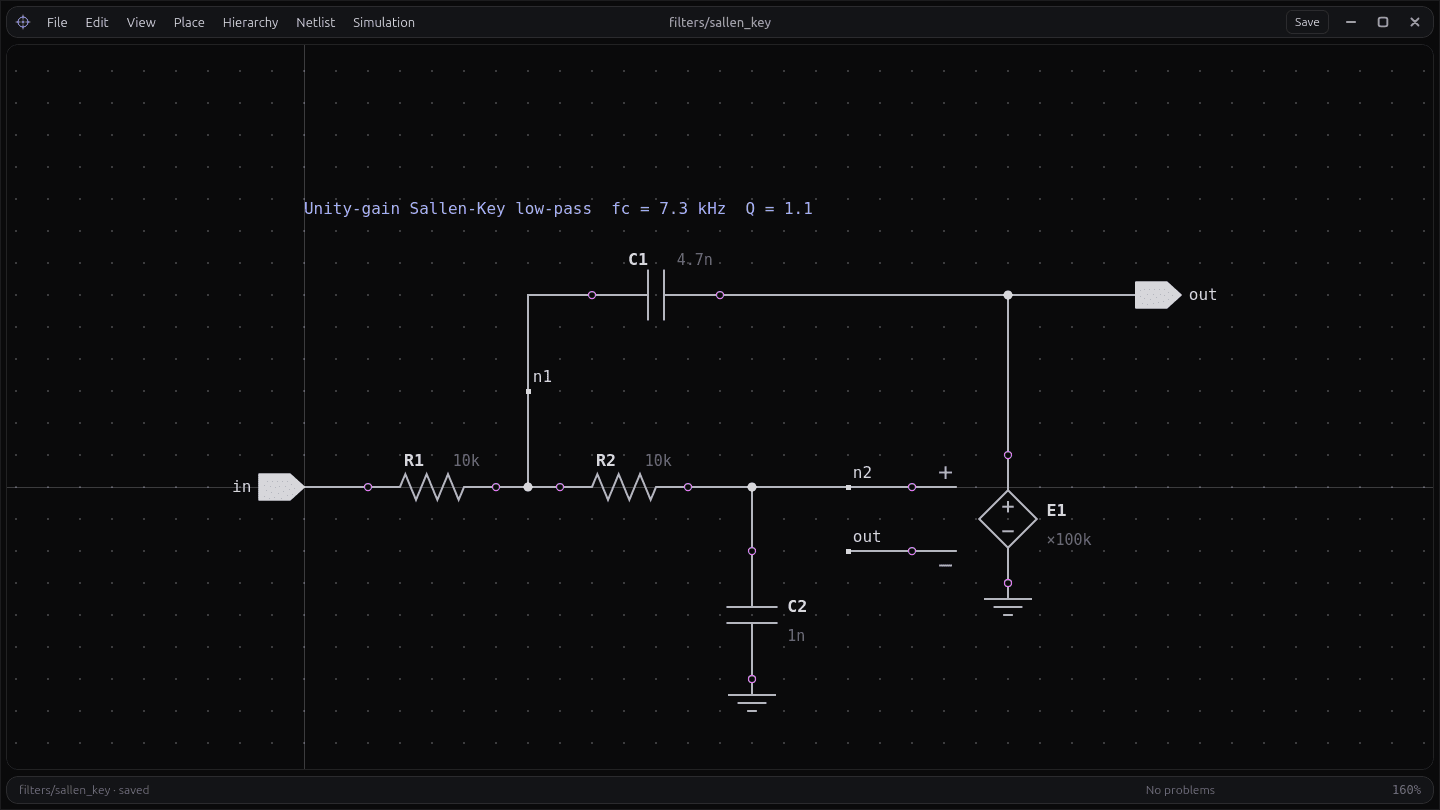
| Schematic editor | Working | Wires, labels and pins, buses and bus taps, instance arrays, hierarchy, cell parameters, notes and checks. |
| Symbol editor | Working | Draw symbols by hand, or generate one from a schematic's pins. |
| Netlisting | Working | SPICE for simulation and CDL for LVS, with hierarchy and parameters. |
| Simulation | Working | ngspice: operating point, transient, DC, AC and noise, at any corner and temperature. Results annotated on the schematic. |
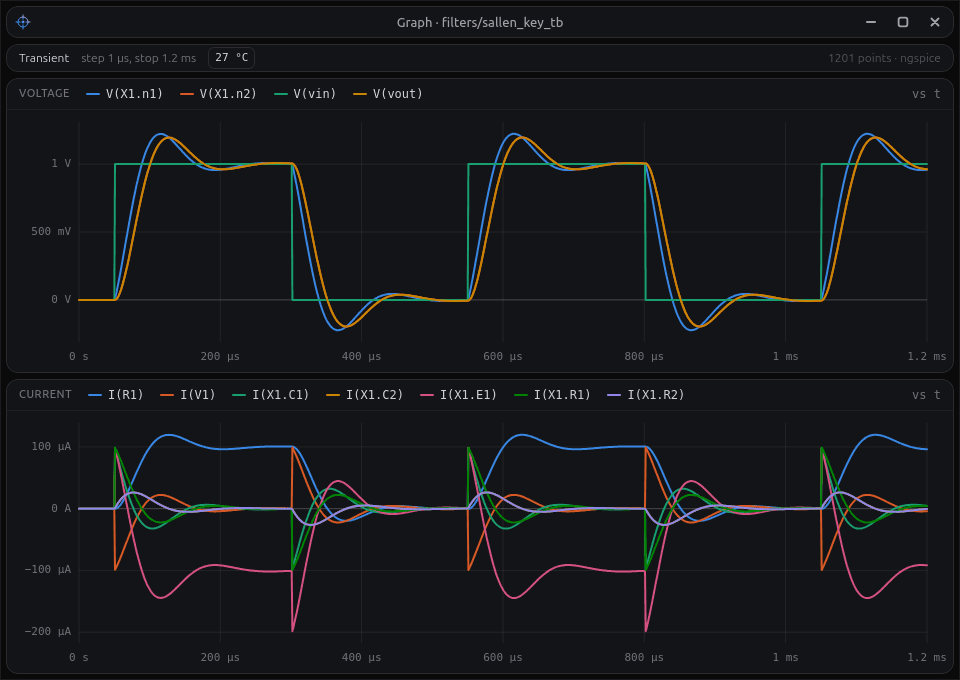
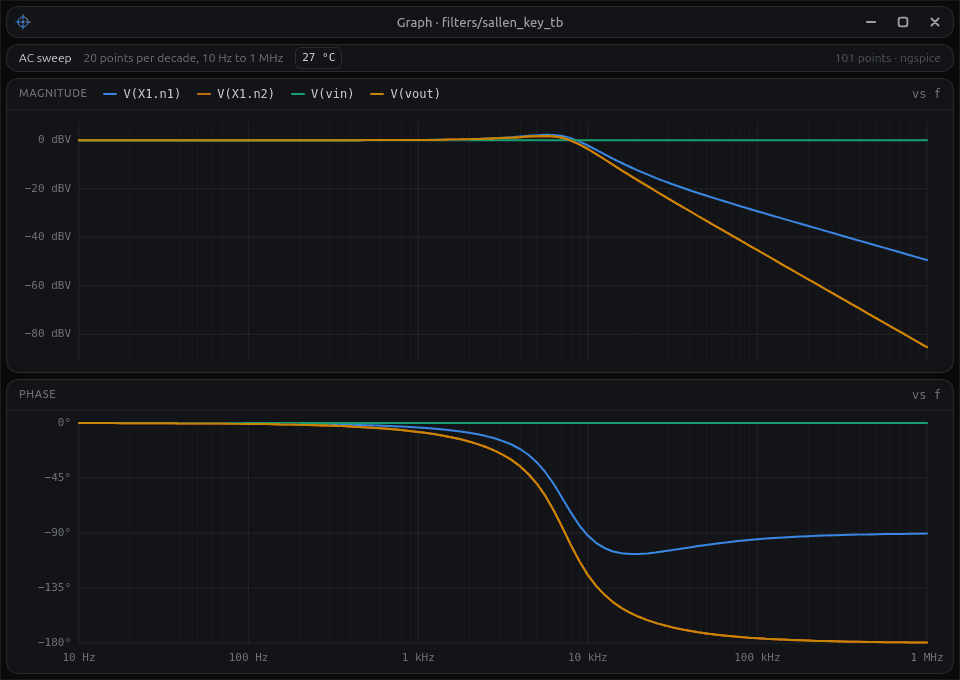
| Waveform viewer | Working | Graph window for voltages and currents, Bode magnitude and phase, and noise. |
| Layout viewer and editor | Next | GDS reading and writing, a fast canvas, then editing. |
| DRC | Planned | A small rule language on top of the Rust engine. |
| LVS | Planned | Extract a netlist from layout and compare it with the CDL netlist. |
| Parasitic extraction | Planned | Resistance and capacitance from layout, back into simulation. |
| Tiny Tapeout flow | Planned | Take a design from schematic to a Tiny Tapeout submission. |
| Cloud jobs | Planned | Run large simulations and checks on a server from the desktop app. |
Screenshots
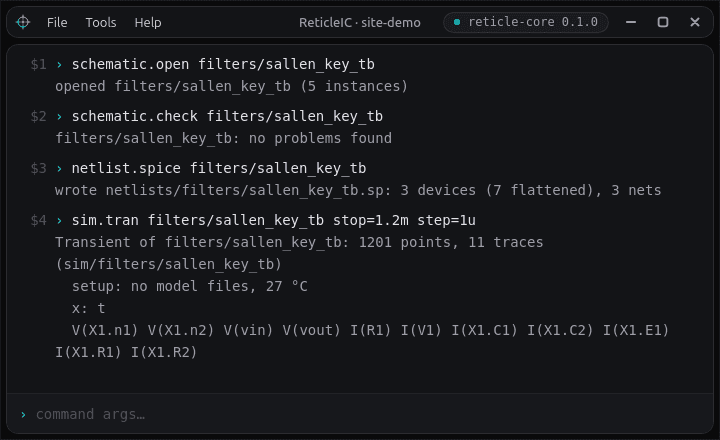
A second-order Sallen-Key low-pass filter, drawn, checked and simulated in ReticleIC. Nothing here is a mock-up; these are the app's own windows.
How it works
- Everything is a command. Typing in the console, clicking a menu and running a script all send the same command lines to one engine, so every session can be logged, replayed and scripted.
- One engine. The engine is plain Rust with no UI code. The desktop app is Tauri with a Next.js interface.
- Plain files. A workspace is a folder with a manifest, libraries and cells. Schematics and symbols are readable JSON that diffs well in git.
- Exact geometry. Lengths are stored as integers, so coordinates never pick up floating-point error.
workspace.init                          make this folder a workspace
library.create filters                  add a library
schematic.new filters/sallen_key        a new schematic, in its own window
schematic.place filters/sallen_key basic/res x=4 y=0 rot=90
schematic.wire filters/sallen_key 6,0:7,0
schematic.check filters/sallen_key      loose ends, unconnected pins, shorts
symbol.generate filters/sallen_key      a symbol from the schematic's pins
netlist.spice filters/sallen_key_tb     a SPICE deck for ngspice
sim.tran filters/sallen_key_tb stop=1.2m step=1u
sim.ac filters/sallen_key_tb from=10 to=1meg
Roadmap
- 1
Schematic and simulation
Done enough to design and simulate real circuits. It keeps improving alongside everything below.
- 2
Layout
A GDS viewer first, built to stay fast on large designs and without a GPU, then a layout editor.
- 3
Verification
DRC with its own rule language, then LVS against the CDL netlist, then parasitic extraction.
- 4
Tiny Tapeout
ReticleIC is intended to work with Tiny Tapeout: draw, simulate, lay out and verify a design, then submit it for fabrication on an open PDK.
- 5
Fewer outside tools
ReticleIC uses ngspice for simulation today. The long-term aim is for each outside tool to be replaced by ReticleIC's own engine once it matches the original.
Updates
- Symbol Editor: lines, polygons, circles and a selection box, with undo.
- Generate Symbol from Schematic places pins on the sides you choose.
- Schematic editor with wire editing, buses, arrays, hierarchy and cell parameters.
- SPICE and CDL netlists, and ngspice simulation with a Graph window.
- Operating-point voltages and currents drawn on the schematic.
- Console command syntax, menus, the Library Manager and a custom title bar.
- Project started: Rust command engine and a Tauri + Next.js desktop console.